Ecoforestry Explained
Ecoforestry is a forest management practice that maintains or restores natural ecosystem richness, complexity, and resiliency, while providing for ecologically appropriate levels of harvest.
Ecoforestry principles are based on the belief that nature has evolved very complex, comprehensive ecosystems which support all life on the planet. Natural forest ecosystems must therefore be conserved to protect the essential processes and functions of nature as Indigenous Peoples have successfully done over millennia with their stewardship. By protecting nature we also protect ourselves and those who come after us.


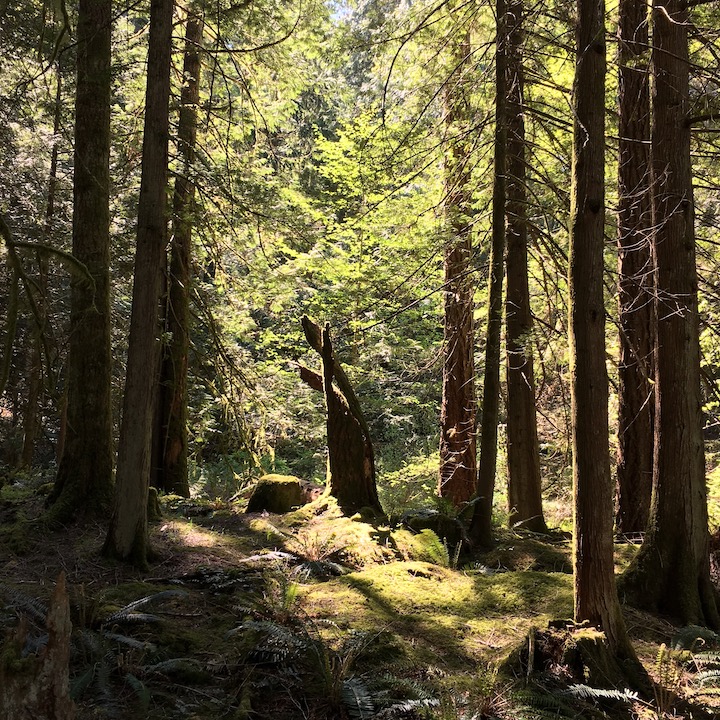


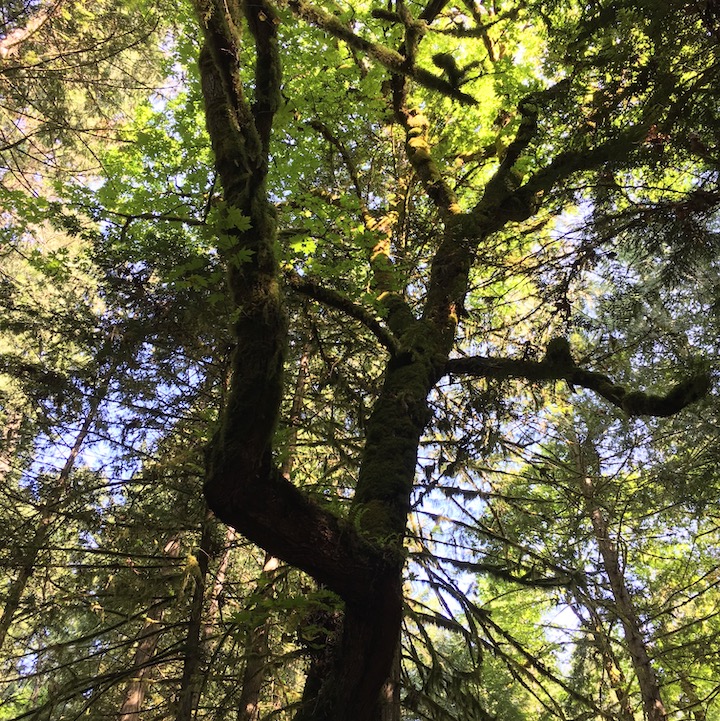

Ecological Integrity is the state of being whole, entire, and undiminished; including functionality. This is the bottom line and the most important goal of management. Otherwise, there can be no true sustainability of any kind, particularly of timber harvesting.
Losing species or dangerously diminishing their natural abundance through forest management is not acceptable. They have intrinsic value and valuable functions in the ecosystem. Timber is not of greater importance than biodiversity, hydrology, climate moderation, soil health, edible plants, recreation, etc. The natural world is the basis for our existence and the basis for our economy.
How we practice Ecoforestry at Wildwood
Just like Merv Wilkinson, we endeavor to keep Wildwood as healthy, intact, and beautiful as possible while deriving some income from it. We want to be as revolutionary and daring as he was, and will adapt our practices whenever we learn that we should change – just as he did. He was interested in and inspired to pursue better ways of creating an income from his forest than by selling logs, and so are we.
Our Ecoforestry approach at Wildwood is based on the “Natural Disturbance Type” of the Coastal Douglas Fir (CDF) biogeoclimatic zone to which Wildwood belongs. This particular “Natural Disturbance Type” is characterized by “infrequent stand-initiating events” which historically have been fires returning on average every 200 yrs. This would naturally result in extensive areas of mature and old forest surrounding patches of younger forest.
Today’s reality is pretty much the opposite, and a little worse, with young forests (less than 80 yrs of age) dominating this “Disturbance Type” and Old Growth (> 250 yrs) occupying less than 1%. This means that animal, fungal, and other plant species which depend on CDF old growth forests are going extinct. At Wildwood though, we are close to the natural age class distribution and we will let it grow older and naturally increase the “dead” wood component (snags, downed trees) to resemble more and more on a small scale what a natural forest would look like in this biogeoclimatic zone. By operating in this way, we will store significant amounts of carbon at Wildwood and make a hefty contribution to climate change mitigation in addition to biodiversity conservation.
Other features of our forest management are:
· Our annual timber harvest will not exceed 30% of the actual timber growth rate (which we can determine
through our permanent sample plots).
· We carefully choose trees according to our list of ranked selection criteria which focus on ecological integrity and safety.
· We use low impact harvesting techniques and leave branches and tops as well as other low-market-value pieces where the tree fell.
· Logs will be processed at least into lumber at Wildwood.
· Tree species which are less frequent at Wildwood are receiving greater attention for retention.
· The market value of tree species will not influence tree species composition at Wildwood.
· No synthetic chemicals (i.e. fertilizer, herbicides, insecticides, fungicides) will be applied.
· We rely on natural regeneration (seeding from the most successful, old trees).
Take a look at our Management Plan and Ecoforestry Checklist to learn more about what we do!
We have also put together a page of extensive ecoforestry resources for more in-depth reading.
Introducing Wildwood - A Success Story from a Damaging Industry.